From fragments and impressions to clear, confident writing
You’re facing up to a piece of writing – any piece – but your overwhelming thought is “I don’t know what I want to say yet.” You probably do, but it’s still tucked away in the recesses of your brain, between shopping lists and that work email you need to remember to write in the morning.
The thing is, writing starts a long time before you’re staring at a blank page (or screen). All those half-finished thoughts, the ideas you wake up with in the middle of the night, the moments in the shower when you think oh, I must remember that! – they’re all part of the process. Writing isn’t just a mechanism for expressing your ideas. It’s also a tool to help you think. If you can learn to catch that thinking before it disappears, you’ll have greater clarity when you do, eventually, sit down to that blank page.
I can’t be the only person who feels like their best ideas come when they’re doing something other than writing. I’ll be walking, listening to music or a great podcast, or even sleeping, and some thought will come to me. Usually it’s a bit like an Impressionist painting – almost more of a feeling than a fully formed thought. Sometimes it will be a fragment, sometimes a visual, sometimes an ending.
These ideas can be the start of something great, but they’re easily lost. No amount of that ‘she’ll be right, I’ll remember’ thinking will work if the idea floats away as gently as it arrived. If you don’t catch it, that fragment will never appear in your writing.
I know it’s old fashioned, but I carry a notebook and pen everywhere (I have very specific requirements: soft cover in a shade that pleases me; unlined (although I’m a recent convert to those ones with dots) and A5 or similar in size. Depending on the size of your handbag or pocket, you might think differently. I know many of you would just use your phone, but the advantage of a notebook is that you can use it at a live event (assuming that, like me, you can write in a decipherable way in the dark!) That means that I can capture those timid flashes of inspiration before they disappear.
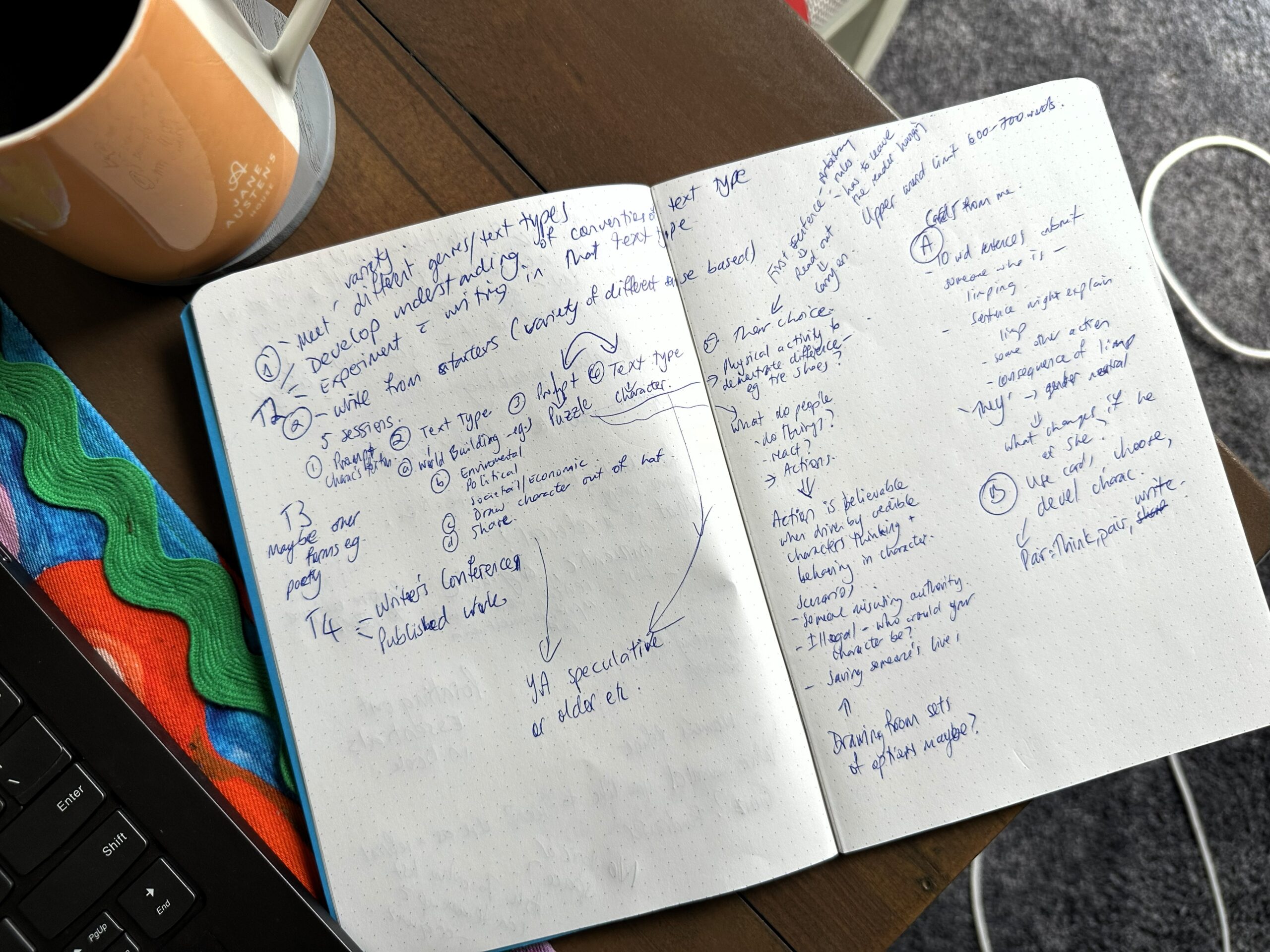
As you can imagine, these thoughts are definitely not ‘proper’ writing. They’re scribbled words and phrases and they exist solely to remind me what I was thinking. Clarity should be the aim of your writing, not the starting point. In fact, as a starting point I advocate chaos. I like to brainstorm on unlined paper – a deskpad or copy paper, for example. I aim to empty my head onto the paper; any messy thought is welcome. I strongly suggest you stay away from a screen at this point. You want the more direct connection that comes with a pen or pencil and some paper. You want to be able to doodle, draw a diagram or connect thoughts with arrows; to scribble something down and scribble something out. And never, never chuck these ramblings away! You may find a later use for a current thought.

I’d call this the pre-planning stage. It happens before the outline and long before your first paragraph. Unless you’re like me with my trusty notebook, it might happen on your notes app, on the back of an grocery list or as a voice memo. It’s not even as organised as brainstorming. Think of it as gathering loose threads before they drift away.
This kind of thinking-before-writing isn’t just personal. In an election year, I imagine it’s exactly what’s happening (or has happened) quietly behind the scenes too — long before speeches are written or slogans are printed.
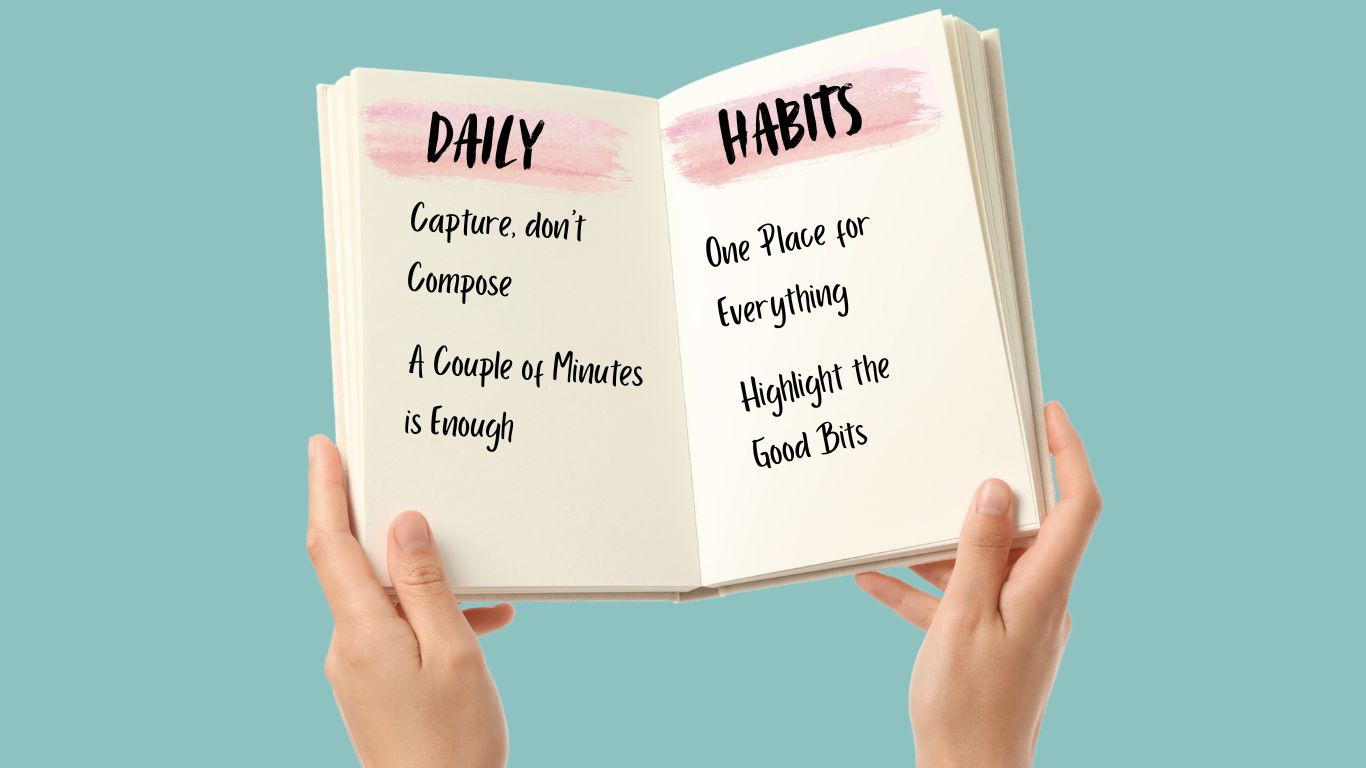
Here comes the useful bit: some small, sustainable habits to turn your vague thoughts into usable material. Remember, this isn’t writing: it’s collecting.
Habit 1: Capture, don’t compose
Write fragments. Phrases. Questions. Observations.
No sentences required.
Habit 2: One place for everything
A notebook, Notes app, Google Doc, voice memos — have one main place to capture those fleeting thoughts
Habit 3: A daily two-minute download
Set a timer. Empty your head. Stop.
Habit 4: Highlight the Good Bits
Later, scan and highlight what still captures your attention.
Forming these small habits is the beginning of lightening the burden of your writing. When you sit down to write for real, you’re not starting from nothing. Instead, you’ve got those flashes of inspiration, thoughtfully provided by your off-duty brain, to build on. You may end up not using any, but even reading them over gives you a gentle kick start – an entry point.
Basically, that blank page isn’t scary anymore, because it isn’t empty.
It’s a new year: traditionally the time for fresh starts. Instead of a punitive, grand approach to resolutions (Eat less! Spend less! Drink less! etc) why not try the no-pressure introduction of a couple of the habits above? Go on, spend some time in a stationery shop choosing the perfect notebook and a smooth-flowing pen. Then try spending 30 seconds every now and then jotting down that thing you just thought.
One resolution I’ve made for 2026 is to pay more attention to public language — particularly in an election year, where words are planned long before we ever hear them. I’m aiming to think carefully about how the messages we see are thought about and made, as well as what they say.
Writing well takes effort, it’s true. But it’s a lot easier (and clearer and more articulate) when you listen to what your brain is trying to tell you. Give it a go!
I’d love to chat with you about your writing needs – call me.