
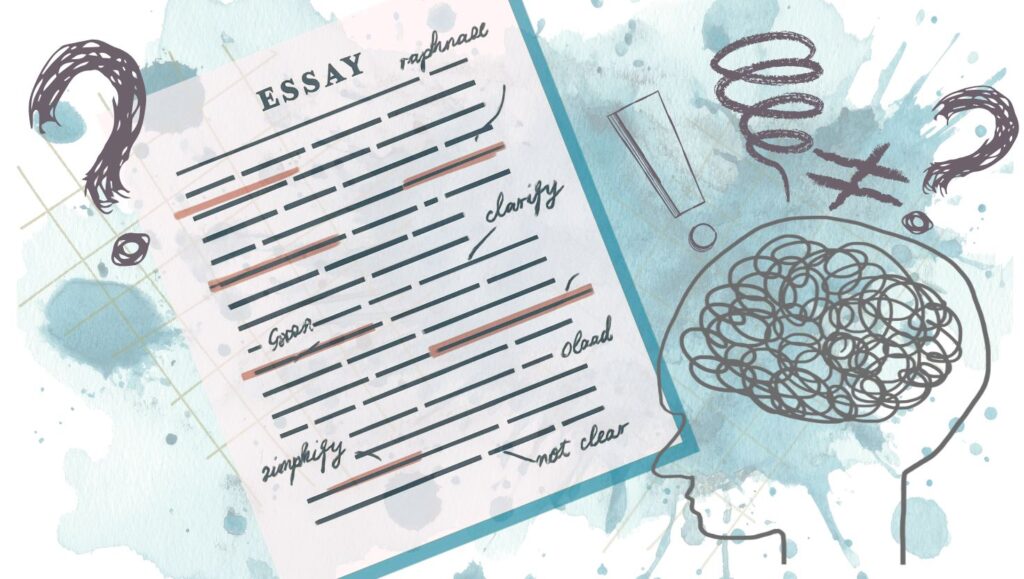
“I’ve got some feedback, but I can’t make head or tail of it. What should I do?”
I hear from a lot of intelligent, capable people who have this frustration. They’re stuck, because they can’t translate the feedback they’ve received into useful actions. They turn to me, expecting to hear how they’ve gone wrong, and are often surprised when I tell them I don’t think it’s them with the problem.
If you’re assessing writing (well actually, this applies to any assessor), you need to be able to clearly:
- Identify issues
- Express those issues in a clear, actionable way
- Give feedback that suits your audience (in my experience, you can’t give the same feedback to a poet and an environmental scientist!)
Why Feedback Often Misses the Mark
Feedback is often expressed in a kind of shorthand and, as an ex-teacher, I have every sympathy with how that happens. If you’re marking your 10th piece with the same issue, it’s very easy to compress what you’re saying (almost like you expect each student to have read each other’s feedback as well as their own.) Let’s face it, assessors are often aiming for efficiency, not clarity. That’s fair enough, if the feedback receiver understands the shorthand – knows what ‘flowery’ means if scribbled in the margin of an essay, for example. It’s not fair though, when the recipient doesn’t speak the same feedback language – if they think, ‘Huh? It’s an essay about Wilfred Owen, not flowers!”
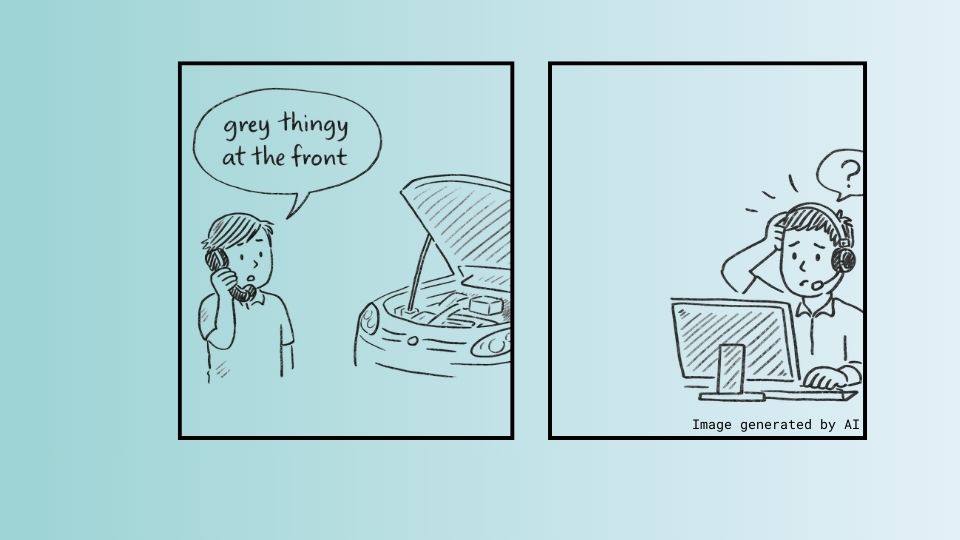
The other issue lies in the supervisor’s/manager’s/marker’s own communication strengths and weaknesses. All too often, they have an intuitive understanding of the issue, but can’t always articulate the fix. When I couldn’t get the charger on my electric car to work, I rang the help desk. (If I tell you that I accidentally rang Honda rather than Hyundai, you’ll probably see where this story is going.) They couldn’t really help me over the phone, largely because the technical vocabulary I was using included phrases like ‘grey thingy at the front.’ I knew what was wrong, but I couldn’t explain it with any clarity.
The Three Hidden Questions Behind Most Feedback
The vaguer the comment, the more potential fixes there are. Take my ‘flowery’ feedback from earlier. This might mean that the writer is using too many adjectives and adverbs. However, it could also refer to a creative or poetic approach to an academic essay, or to a lack of formality.
If this sounds like you, on either side of the feedback equation, think about these simple questions:
- What confused the reader?
(Where did meaning break down?) - What was the reader expecting instead?
(Structure, evidence, clarity, depth?) - What kind of change is actually being asked for?
(Sentence-level, paragraph-level, or thinking-level?)
Common Feedback Phrases — Translated
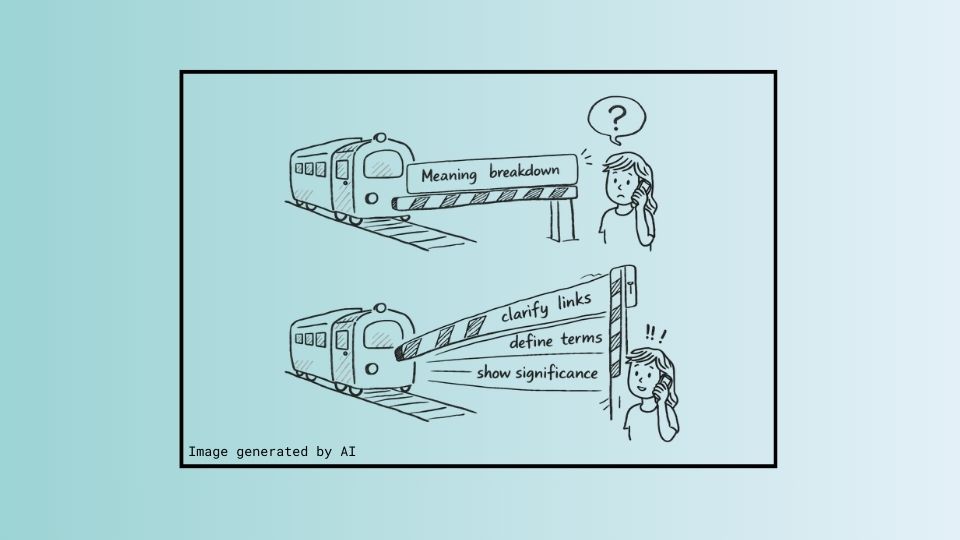
These questions have a further use for the writer: they help us to not take the feedback personally. Because if we do take it personally, it’s hard to learn from it. Feedback isn’t a personal judgement, it’s a clue about where meaning broke down. Think of it like the barrier arm on a railroad crossing – your reader can’t get across until you raise it by making your meaning clear.
Here are some commonly used feedback phrases, with possible translations:
- “Be more analytical” → You’re describing, not explaining significance. Try starting some sentences with ‘This suggests/It follows/Significantly’
- “This section is unclear” → Your reader can’t see how ideas connect. Try some connecting words or phrases like ‘however/conversely/in addition/on the other hand.
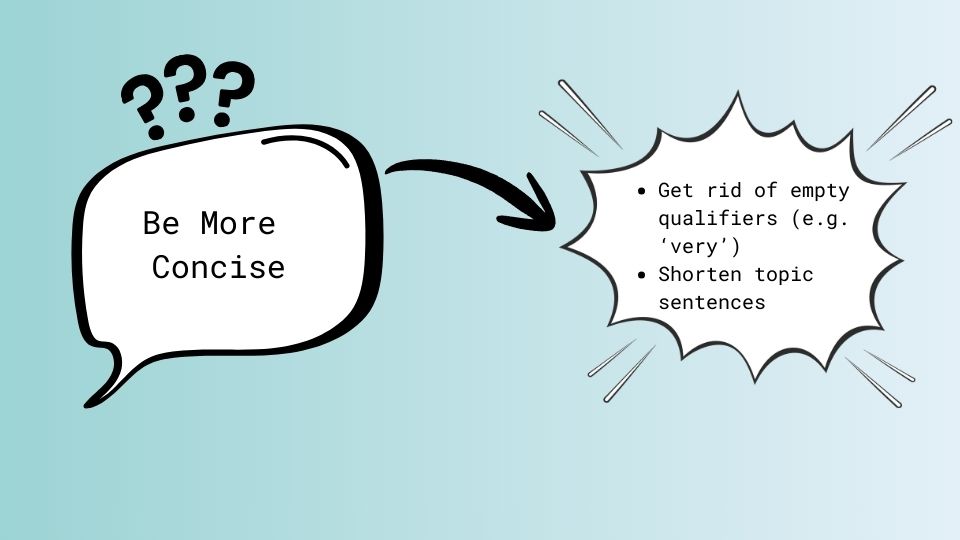
- “Needs tightening” → Too many ideas competing for attention. Try reverse planning: for a paragraph you’ve already written, reduce it to one main point of 10 words or less. If you can’t, you may well have too much going on.
- “Develop this further” → The idea is promising, but stops too soon. Try testing your evidence, paragraph by paragraph: Is there any evidence in this paragraph? is the evidence relevant for my main point? Why is it valid? HOW does it prove my point? You need to address all those questions in your explanations.
- Why Feedback Feels Personal (Even When It Isn’t)
A short, compassionate section.
Cover:
- writing is thinking made visible
- criticism of writing can feel like criticism of intelligence
- the emotional reaction is normal — and manageable
Reinforce:
Distance + translation = progress
I know, it can be hard not to take it personally. It’s because writing is our thinking made visible, and so any criticism can feel like an attack on our intelligence. This emotional reaction is completely normal and understandable, but not, in the end, particularly useful.
The way to manage, or mitigate, this response is to remember that:
Distance + translation = progress
What does this mean? Well, when you first read the feedback, you’re still attached to the thinking that produced the piece: your brain is defending, explaining and feeling judged. If you can get some distance – maybe even just an hour or two – and then go back to the work, your perspective might change. If time isn’t possible, you could try creating an artificial distance by changing the look of the feedback (font/size/highlighter) or imagining you were the one offering it – how would you express yourself? Getting that space shifts your mindset from ‘How dare they’ to ‘Why didn’t it work for them?’
The ‘translation’ part of the equation is where you work to understand the reviewer’s intent. You might try, as I just said, putting it in your own words. You might try turning it into actionable steps: ‘I need to…’. You might decide whether the feedback applies to word choice, sentence structure or overall organisation. All of these help your brain shift from defence mode to analysis and solutions.
If you can achieve both distance and translation, you’re less reactive and more inclined to see comments as informative rather than judgemental. This enables you to make deliberate, effective changes. It also helps you identify if the problem is the feedback itself – in which case, you have a clearer, more specific way to approach your advisor.
- The Bigger Idea (quietly sitting underneath)
You may have noticed that I’m writing about more than just feedback. All this applies whenever there’s a communication breakdown in writing. If you’ve found yourself failing to understand, or be understood, try stepping back, decoding what’s been said and checking you’ve got the meaning right. Then you’re on solid ground for your next action. That’s how to make writing make sense, in practice.
How to Respond to Feedback Productively
If this has all resonated with you, here’s a simple process to try, the next time you get feedback (instead of panic-editing!):
- Step away briefly
- Rewrite the feedback in your own words
- Decide what level the change sits at:
- idea
- structure
- sentence
- Make one deliberate change at a time
Summary
Feedback confusion isn’t limited to academic institutions. It happens whenever language is vague or compressed, or whenever one party makes false assumptions about the meaning or understanding of the other. The good news is that learning to notice how meaning gets lost or distorted is a skill anyone can acquire.
We’re all in a year of giving feedback to our government – ultimately with our vote, but in our comments and responses to their communications along the way. Everything I’ve said applies to those exchanges – it’s a great way to practice the art of constructive criticism!
The essential takeaway of what I’ve said is that feedback isn’t a verdict. It’s data. Possibly data that you have to translate, but once you’ve done that, it becomes a useful tool in your progression to your goals.
Sometimes, making your writing make sense starts with making someone else’s writing make sense for you.