How to Survive Election Year Without Chucking Something at your Telly
If you’ve ever struggled to make sense of political speeches, you’re not alone. These Election Bingo cards are a fun, practical way to analyse political language, identify techniques, and understand how meaning is shaped — making them perfect for everyday viewers and for NCEA English unfamiliar text practice.
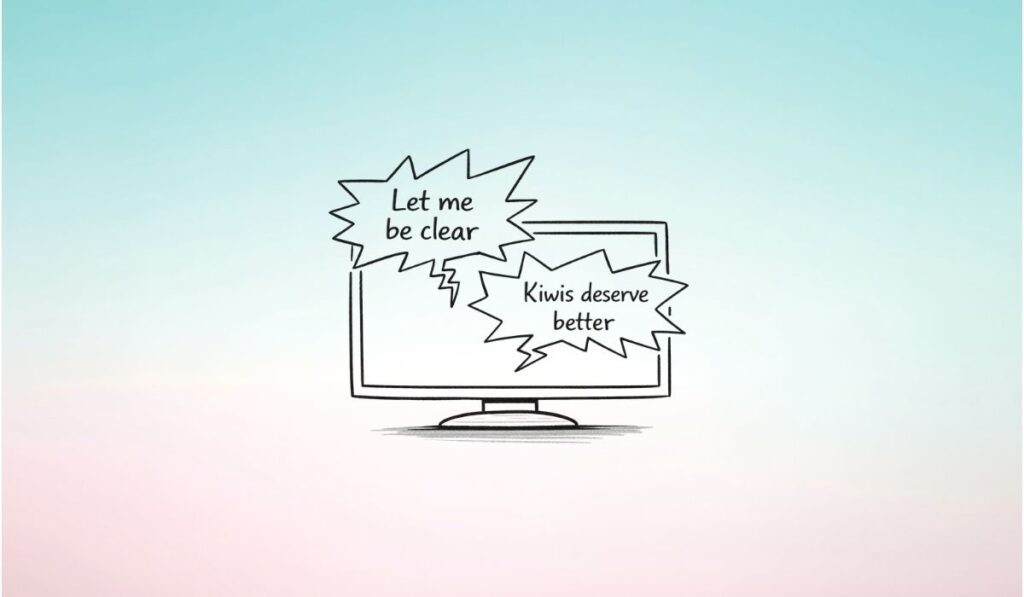
I’ve been scrolling, watching interviews and hearing speeches by politicians – doing my best to engage with what they’re saying in this election year. But it’s hard work: trite, meaningless cliches, statements without substance, personal attacks – and the underlying desperation for votes that smacks you in the face. Just the same tired old phrases: ‘Kiwis deserve better.’ ‘Let me be clear.’’ “We’re focused on delivering.’ The campaign hasn’t really started yet, and I’m already over it.
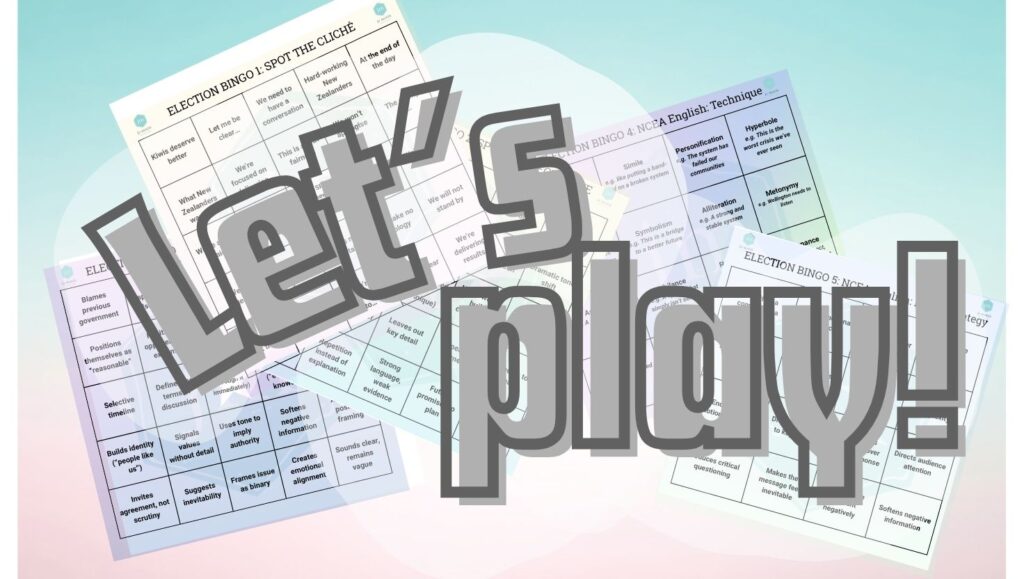
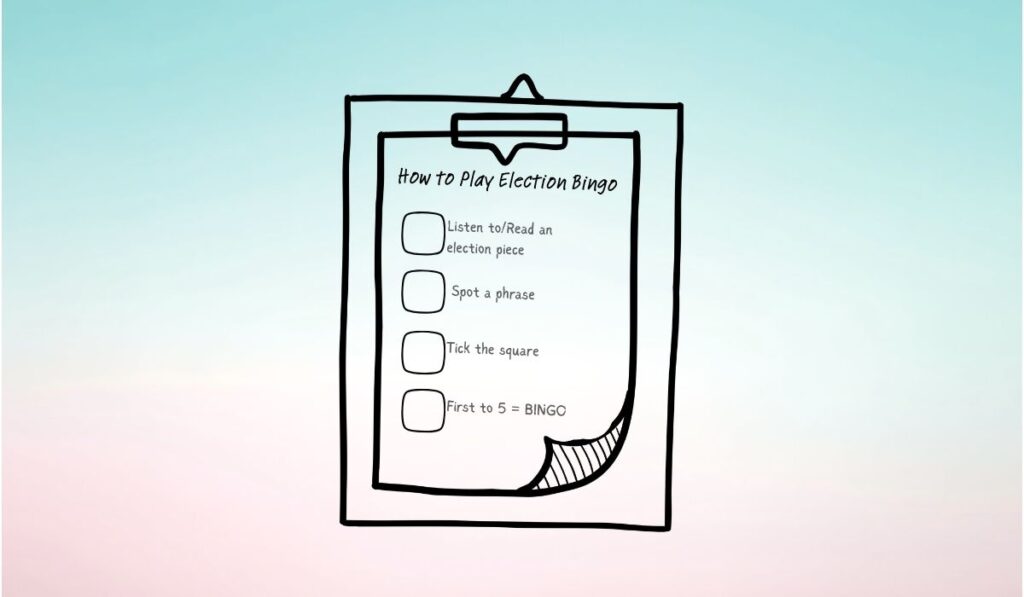
Then, the other day, I had a brainwave: I could dramatically improve the election coverage with one small addition – bingo cards. What if I turned the whole process into a game? I got a bit carried away – I was going to just make one card, but then I got to thinking about how, since the techniques and strategies politicians used are often transparent, it might be fun to spot those as well. I’ve ended up with three.
They’re fun no matter which party you support (let’s face it, everyone’s using the same playbook). They’re all about spotting language use and its effects, and how once you start noticing patterns, you’ll spot them anywhere.
I’ve retrospectively convinced myself that they’re highly educational, especially for NCEA English students working on unfamiliar text and language analysis, because you could use them to:
- practice identifying techniques
- work out the purpose and effect of repeated words and phrases
- help develop a broader understanding of how political language works
Mainly, though, they’re for fun – for:
- yelling at the television
- family competitions
- playing with friends
- maybe even for the odd drinking game, if that’s your thing!
Think of these bingo cards as a small act of democratic self-defence. You’re saving the nation by saving your own sanity.
The cards
Level 1 — Spot the Cliché (Political Language Examples)
This is the easiest one. You simply have to hear the words in each square – “Kiwis deserve better”, for example, or “Let me be clear”. This card is very accessible – fun for the family (Insofar as watching political messages can be fun, of course. I’m taking no responsibility if you’re still bored.).
Clichés hang around because they’re neutral, widely understood and safe to use – they don’t offend people. They’re the path of least resistance for both parties – no thinking required. Have fun spotting them!
Level 2 — Spot the Technique (Language Techniques in Political Speech)
For this card, you need to do a bit more – instead of just hearing the words, you’re noticing what they’re doing. Are they making a deliberately vague promise, or repeating a key phrase? Tick!
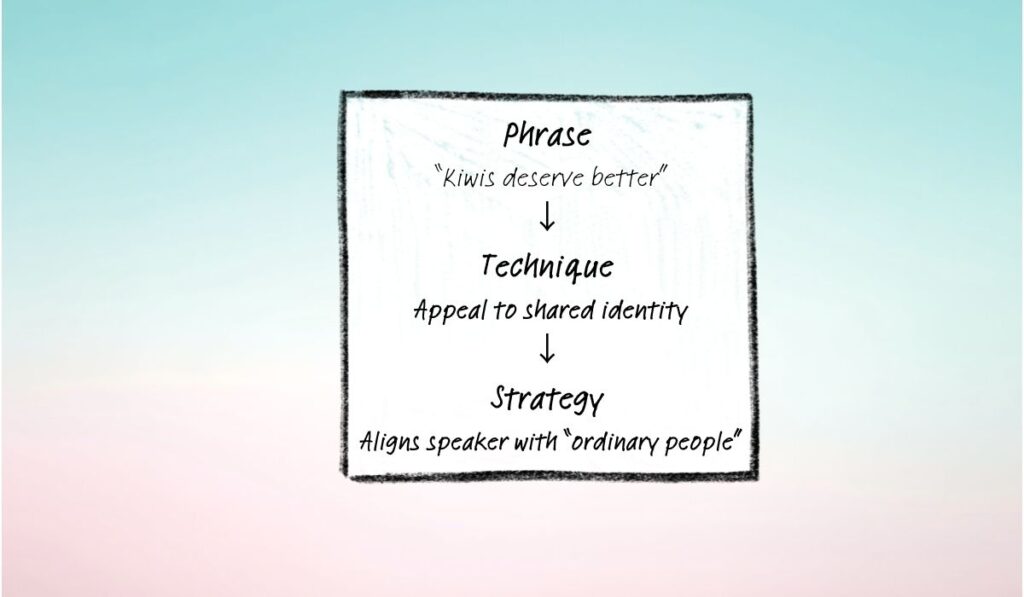
Level 3 – Spot the Strategy (Understanding Political Messaging)
Still too easy? Try working out the political strategy underpinning the phrase. How are they trying to get your vote – or trying to avoid losing it? Are they narrowing the debate? Reframing the question?
In these cards, you’re no longer just listening to the message – you’re working out how it’s built. I love getting to grips with why language decisions are made – it helps me understand what the writer/speaker actually wants from me.
Using the Cards Together
You don’t need to stop with using them individually, either. For example, every time you hear one of the cliches in Level 1, you could ask:
- What technique is being used?
- What broader strategy might be happening?
These are exactly the kinds of skills students need when analysing unfamiliar texts in NCEA English — identifying techniques, explaining effects, and thinking critically about meaning. Very useful for classrooms, political discussions…and family arguments.
But wait — there’s more. (I know. I got carried away.)
Alongside these cards, I’ve also created a second set designed more specifically for English students and teachers. These ones focus on literary techniques — metaphor, repetition, juxtaposition, that kind of thing — with examples drawn from political language. There are two of them – the first names techniques and gives one example, to help players find more, and the second looks at effect, but in terms of strategy: what the language is doing to the audience, and why it works. In other words, it’s unfamiliar text practice… disguised as a game. Or possibly the other way around.
These aren’t perfect, and they’re not road tested (I only just thought of them!). So make of them what you will.
Why This Matters: Language, Critical Thinking, and NCEA English
Here’s the thing. At first, I was just thinking about ways to survive the election campaign. But we all know that language shapes thinking, and that the more clearly we hear language, the more clearly we can think about it. So in a small way, I think these cards will help us do that.
Best of all – the cards are free! You’ll find them on my website as a free download here – go ahead and grab yours. If nothing else, they may help you survive the next six months.