
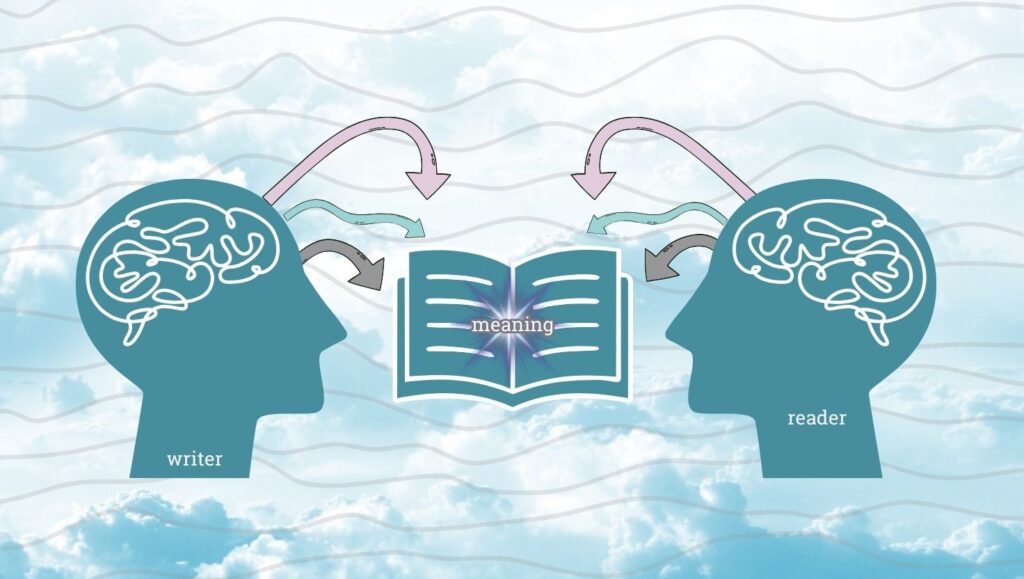
Understanding your audience is one of the most important — and most overlooked — writing skills. Whether you’re writing a report, a website, or a social post, meaning doesn’t sit neatly in your words. It’s shaped by how your reader interprets them.
Let’s imagine you got two political pamphlets in your letterbox this morning — one from your current MP and one from their opposition. Let’s also imagine you actually read them instead of chucking them straight in the bin. Chances are, you preferred one over the other — and chances are, you were predisposed to that preference before you began.
That’s because readers don’t arrive empty-handed. We bring our background, beliefs, politics, culture, knowledge and experiences to everything we read, and they influence how we receive it.
That doesn’t mean readers just make things up. Writers make deliberate choices too. Whether they’re trying to entertain, persuade, explain or vent, they’re shaping language in the hope that it lands a certain way.
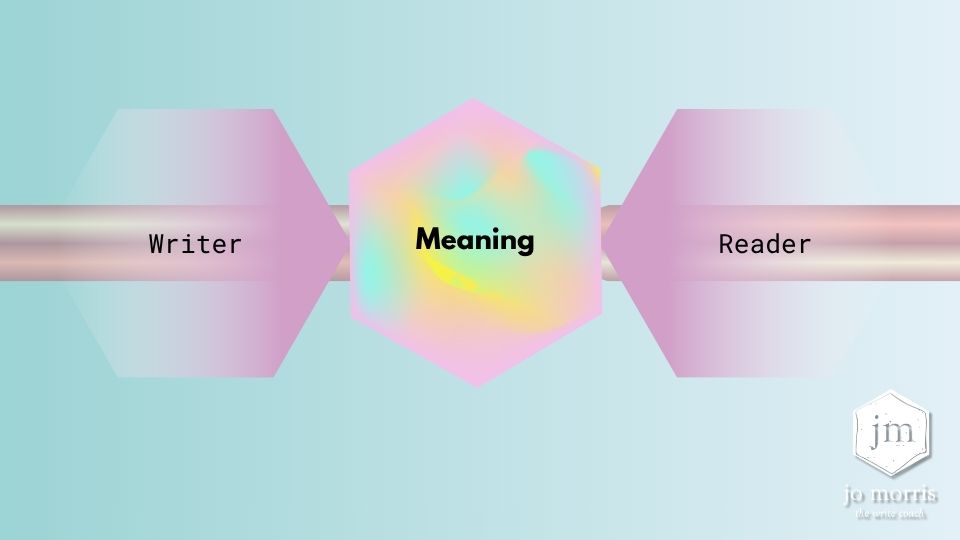
Meaning, then, doesn’t belong entirely to the writer or the reader. It’s made in the meeting between them.
So who controls meaning? Both sides do — and neither side does completely. Meaning is a negotiation between what the writer puts in and what the reader brings. When that balance holds, communication works. When it tips too far one way, things get more interesting — and often more messy.
When Readers Take Over Meaning (And Why Writing Gets Misinterpreted)
One of the clearest places you can see readers taking charge is in fandoms — particularly in the context of something like Heated Rivalry and the actors associated with it.
Heated Rivalry is a recent example of a text that has grown well beyond itself — not just because of the story, but because of what audiences have done with it afterwards.
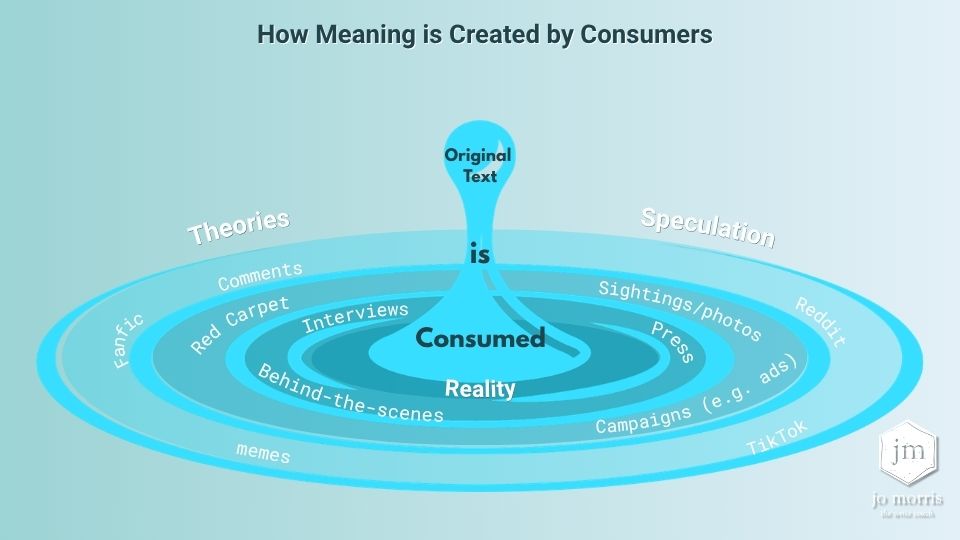
I loved the show, but it’s what’s happened since that has fascinated me. Specifically, I’ve been gripped by how the “text” has stopped being just the six episodes: how viewers have inserted themselves to make their own meanings.
When a show satisfies or exceeds expectations, viewers often don’t want to leave its world. They want more of the feeling it gave them — and because the official text is finite, they begin to extend it. They infer, speculate, imagine and gap-fill. Meaning starts to expand beyond what was actually written or performed.
Online spaces, fan discussions, TikToks and comment threads don’t just reflect individual readings, they amplify them. An interpretation that might have been tentative, like speculation about the ‘real-life’ sexuality or relationships of the actors, becomes shared, repeated and strengthened. Before long, it starts to feel obvious – true – even if it began as guesswork. The actors’ real lives become part of the story.
A detail like a look, a gesture, a photo, a red carpet appearance, even an offhand interaction, becomes “readable”. Not just as itself, but as evidence or confirmation of a larger story the audience is collectively building. In other words, the meaning of the text becomes socially constructed: the boundaries between the text and reality blur.
A photo of two actors together — for example, François Arnaud and Connor Storrie — doesn’t just sit as a neutral image. It gets interpreted, layered with meaning, folded into existing narratives. And those interpretations can quickly take on a life of their own — sometimes positive, sometimes intrusive, sometimes entirely detached from the intentions or comfort of the people involved.
Speculation becomes a kind of social currency. In these fandoms, being the person who notices something, interprets something, who “reads between the lines” has value. It creates engagement, belonging and status. But it also creates momentum. The more something is discussed, the more real it begins to feel.
The actors can participate in this creation with interviews and appearances, they can ignore it or they can explicitly reject it. Heated Rivalry actors, for example, made the following joint comment after racist comments about Hudson Williams:
“Don’t call yourself a fan if you share racist, homophobic, biphobic, misogynistic, ageist, ableist, parasocial, bigoted comments of any kind,” the pair wrote. “None of us need your hateful ‘love’… We all respect and support and love each other and are on the same side. If you can’t accept that gtfoh.” (Francois Arnaud, Hudson Williams etc).
Even this comment, however, became part of the fans’ constructed narrative (Who wrote it? Who was ‘made’ to share it?). Fans can resent any pushback against the story they’ve contributed to – that they feel that they own.
Once something is out in the world, it doesn’t belong entirely to its creator anymore. It gets picked up, reshaped, reinterpreted and even remade by the people encountering it — each bringing their own desires, assumptions, and perspectives.
How Political Language Shapes Meaning (And Influences Readers)
If fandom shows us what happens when readers take over meaning, politics shows us what happens when speakers/writers try to get there first.
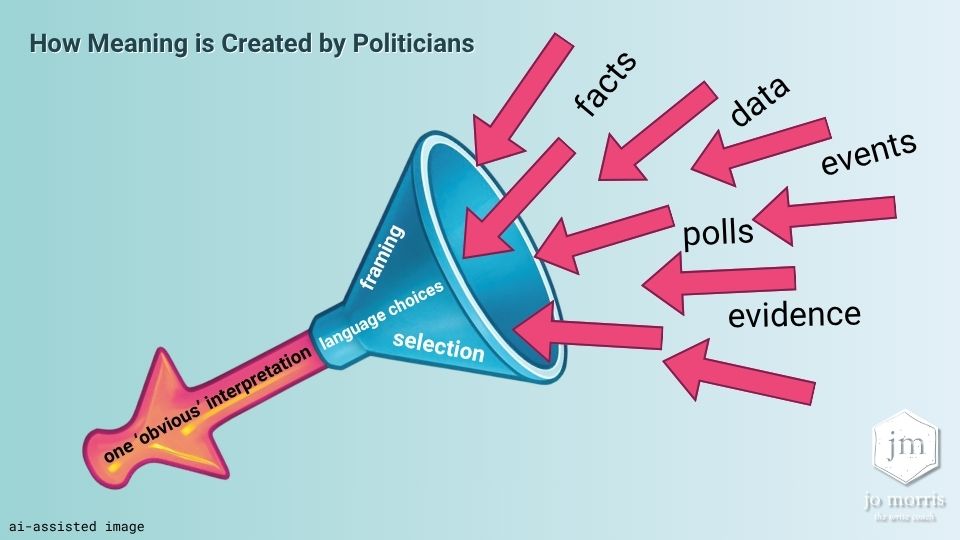
Political language rarely arrives as a neutral description of events. It comes pre-loaded — carefully shaped so that by the time you hear the “facts”, you’re already being nudged toward a particular interpretation.
In other words, politicians don’t just present information. They present a reading of that information.
You can see this clearly in the way issues are named.
Take the phrase “cost of living crisis”. That framing doesn’t just describe rising prices. The word ‘crisis’ signals urgency, pressure and impending disaster. The reader is told how to feel about the situation before they’ve had a chance to assess it. By contrast, using a phrase like “economic headwinds” to describe the same situation softens it, making it sound external, temporary, and less directly attributable to decision-making.
Similarly, think about how keen politicians are to assign blame.
When a policy fails or a problem worsens, it’s rarely described in neutral terms. Instead, we hear versions of:
- “Labour’s failure”
- “National’s cuts”
- “years of neglect”
- “reckless spending”
In New Zealand politics, terms like “back office spending,” “frontline services,” “hard-working Kiwis,” or “wasteful bureaucracy” do a lot of this work. They don’t just describe. They sort people and priorities into moral categories and reduce complex situations to simple emotional choices. The audience is invited to stop asking what’s going on here? and start thinking who’s to blame?
You can see this dynamic in the language used by Christopher Luxon around “fixing the basics”, or by Chris Hipkins pushing back on “cuts” and “priorities”. These aren’t just policy discussions — they’re competing interpretations of reality, each designed to feel like common sense.
If they succeed in convincing you their framing is accurate, nuance becomes much harder to access. If something is labelled a “crisis”, then disagreement can sound like denial. If something is framed as “common sense”, then questioning it can feel unreasonable. If a decision is described as “reckless”, then defending it starts to look like poor judgement.
The language works to stop critical thought by using emotional ‘buttons’. Words like “hard-working Kiwis”, “taxpayer money”, “frontline services”, or “bureaucracy” don’t just convey information — they activate values, identities, and loyalties. They guide the audience toward a particular stance before any detailed argument has even begun.
And importantly, this kind of language doesn’t just suggest a reading — it often tries to close down alternatives.
Where fandom leaves space for multiple interpretations (however messy that becomes), political language often aims to narrow the field: to move quickly from this is complicated to this is obvious.
In a political context, the goal isn’t just to be understood, it’s to be agreed with. After all, being agreed with means votes.
How to Write Clearly for Your Audience
Your job as a writer is not to control every possible reading. That’s impossible. Readers will always bring themselves to your words.
But you shouldn’t leave all the interpretive work to them, either.
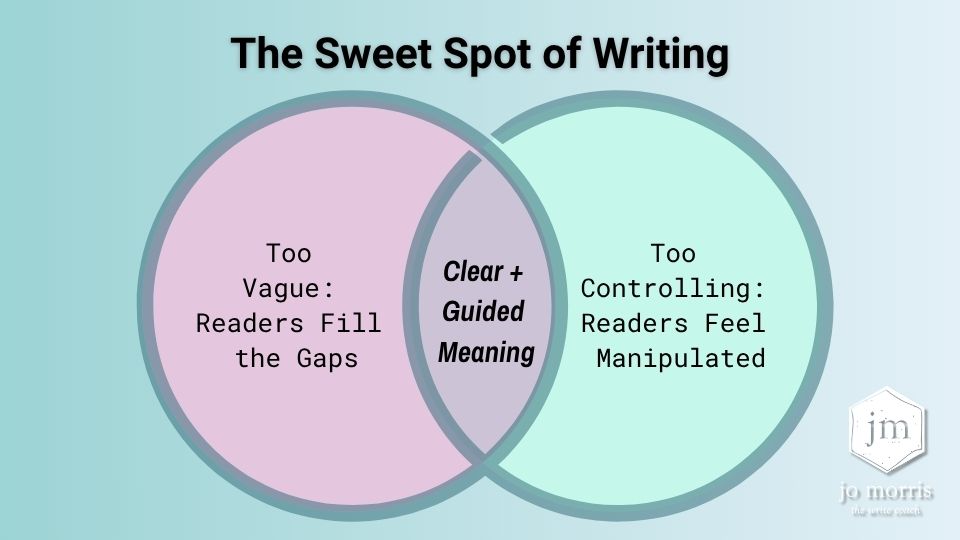
Weak writing leaves too much room for accidental interpretation. Manipulative writing leaves too little room for independent thought. Good writing sits somewhere in the middle: it guides meaning clearly without trying to bully the reader into a conclusion.
That means thinking carefully about what your reader needs from you. What context are they missing? What assumptions are you making? Where might they reasonably misunderstand you?
It also means resisting the temptation to over-steer. If there are too many assertions without evidence, too much emotional loading, too much insistence that your interpretation is the obvious one, your writing starts to feel defensive, simplistic or controlling.
Skilled communicators know that words don’t just carry information; they shape interpretation. The ethical challenge is to use that knowledge responsibly.
Your goal is not to force meaning. It’s to make your intended meaning easier to reach — and harder to distort.
How to Make Your Writing Clearer
- Think about what your reader already knows (and what they don’t)
- Define key ideas instead of assuming shared understanding
- Avoid emotionally loaded language unless it’s intentional
- Check how your wording might be interpreted differently
- Aim to guide meaning — not control it